Severe weather on the high plains of Riverton can develop rapidly, bringing sudden thunderstorms that threaten your vehicle’s exterior. Small hailstones often fall at speeds of about 25 mph, which is fast enough to leave deep, costly dents in a car’s hood, roof, and trunk. Knowing how to react when a storm hits is the first step in protecting your vehicle’s body panels and glass from severe impact.
The most reliable way to prevent hail damage is to find covered parking immediately. If a storm is forecast, parking inside a home garage, a multi-level parking deck, a gas station canopy, or even under a bridge provides the best physical barrier against falling ice . If you are already driving when the storm begins, safety guidelines recommend slowing down gradually, pulling over as soon as it is safe to do so, and remaining inside the cabin until the hail stops completely .
When overhead shelter is unavailable during an active storm, you can minimize glass breakage by positioning your vehicle at an angle. This forces the falling hail to strike the heavily reinforced windshield rather than the thinner, more fragile side windows . If your vehicle has already sustained damage during a recent storm, our team at Fremont Auto Reconditioning is ready to assist. Drivers can find our facility at 1575 N Federal Blvd , or you can speak with a technician by calling (307) 856-6348 to discuss our professional dent and glass restoration options.
Table of Contents
- Selecting the Right Protective Gear and Hail-Proof Car Covers
- Evaluating the Limits of Carports and Temporary Shelter Options
- Do Paint Protection Films Guard Against High-Impact Hail Damage?
- Navigating Auto Insurance Claims and Reconditioning Cost Trade-Offs
- Answers to Common Questions About Vehicle Hail Protection and Repair
- Restoring Your Car’s Finish with Professional Paintless Dent Repair
Selecting the Right Protective Gear and Hail-Proof Car Covers
For vehicle owners without access to a permanent garage, investing in specialized protective gear is a highly effective preventative measure. Standard, single-layer car covers offer virtually no defense against falling ice, as they are engineered solely to shield paint from dust, light rain, and UV rays. Instead, look for dedicated hail car covers built specifically to absorb heavy impacts.
To protect against golf ball-sized hail, a cover typically requires at least 4 to 6 mm of high-impact foam padding. These covers generally feature a multi-layer construction, including a weather-resistant polyester or polyethylene outer shell, a thick middle layer of shock-absorbing foam, and a soft fleece or cotton inner lining to prevent scratching the clear coat. For maximum protection against severe storms, inflatable car covers utilize a built-in blower to create a pressurized, protective air cushion around the entire vehicle, which can successfully deflect hailstones up to softball size.
If a storm is imminent and you do not own a commercial cover, improvised DIY options can help soften the impact of falling ice . Layering the roof, hood, and windshield with thick moving blankets, comforters, rubber floor mats, or flattened cardboard boxes can absorb some of the kinetic energy. Secure these materials tightly with bungee cords or rope to keep the wind from blowing them away. While these household items are not completely foolproof, they can significantly reduce the depth and severity of eventual dents .
Evaluating the Limits of Carports and Temporary Shelter Options
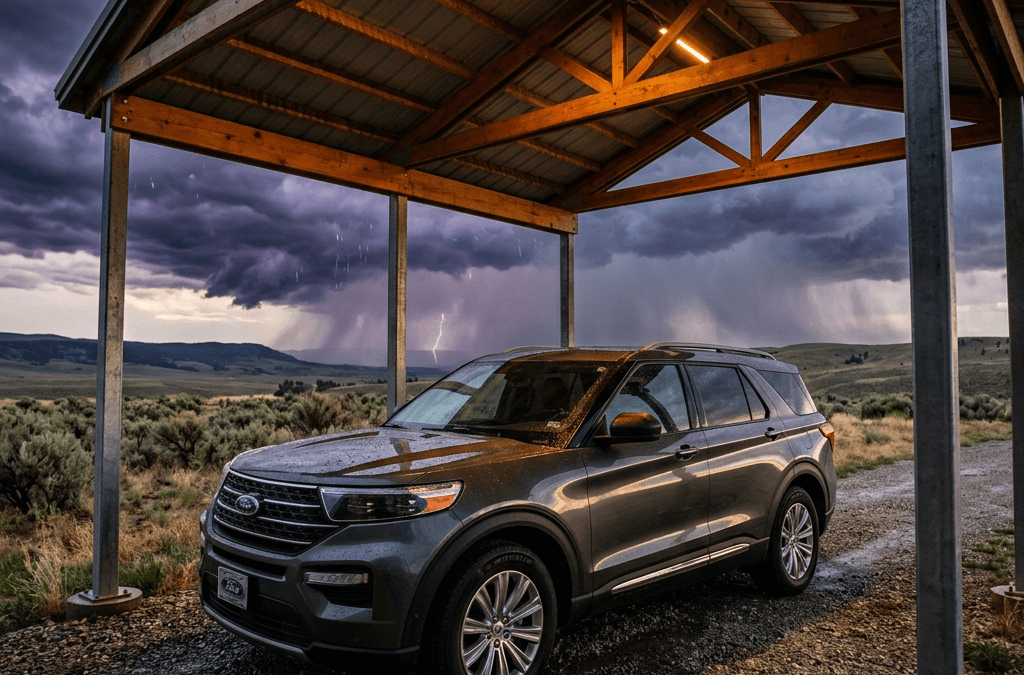
Many vehicle owners rely on carports as a convenient alternative to a traditional garage. While a metal or polycarbonate carport provides excellent overhead shelter from vertically falling hail, severe storms are rarely accompanied by perfectly calm winds. High-velocity wind gusts can drive hailstones sideways, rendering a basic open-sided shelter only partially effective.
To fully protect a vehicle from blowing, angled hail, an open-sided carport requires additional modifications. Installing heavy-duty fabric side panels, windbreaks, or permanent metal siding along the sides most vulnerable to prevailing winds can block angled impacts. Without these side barriers, a vehicle parked near the outer edges of a carport remains highly exposed to wind-driven ice.
Temporary pop-up shelters and fabric canopies present their own set of challenges during severe weather. These structures are often lightweight and can easily collapse under the weight of accumulated ice or buckle under high wind loads. If you rely on a temporary canopy, ensure it is anchored securely to the ground with heavy-duty anchors or weighted bags, and monitor the storm closely to prevent the structure itself from blowing over and causing secondary damage to your vehicle’s bodywork.
Do Paint Protection Films Guard Against High-Impact Hail Damage?
Paint protection film (PPF) is widely recognized for its ability to shield automotive paint from road debris, rock chips, and minor abrasions. This thermoplastic urethane film is applied directly to the painted surfaces of a vehicle, providing a self-healing barrier that preserves the factory finish. However, understanding the physical limits of PPF is crucial when preparing for severe weather events.
While PPF is highly effective at preventing paint chips, scratches, and scuffs caused by small, fast-moving environmental hazards, it cannot absorb the heavy, blunt-force impact of large hailstones. The underlying metal panels can still easily dent even if the film prevents the paint from cracking or chipping. In essence, PPF helps keep your paint intact, but it does not make your vehicle’s metal panels completely hail-proof.
For comprehensive protection, PPF should be viewed as a secondary line of defense rather than a standalone solution. Combining paint protection film with a padded car cover or covered parking ensures that both the structural integrity of the metal panels and the cosmetic quality of the paint finish remain fully protected. If a hailstorm does leave dents beneath your vehicle’s film, specialized reconditioning techniques can often address the metal deformation without destroying the expensive protective film.
Navigating Auto Insurance Claims and Reconditioning Cost Trade-Offs
Understanding your auto insurance policy is essential for managing the financial impact of storm damage. Comprehensive coverage is the specific component of your policy that helps pay for repairs to the auto body, windshield, and cabin interior caused by hail . If you carry only liability coverage, your policy will not cover any storm-related repairs, as liability insurance is strictly designed to cover damage you cause to other people and their property.
When drivers bring their vehicles in for post-storm inspections, they often ask whether a comprehensive insurance policy covers every dent or if they should pay out of pocket to avoid a rate hike. For minor dent clusters, paying for reconditioning directly can sometimes cost less than your comprehensive deductible, especially if you have a high deductible. However, widespread hail damage across multiple panels quickly adds up, making an insurance claim the most practical route.
Following a storm, it is important to perform a thorough visual inspection of your vehicle once it is safe to go outside . Check for dents in the metal panels, cracks in the windows and windshield, paint chips, and damage to the headlights, taillights, or side mirrors . If you discover shattered glass, cover the opening with plastic sheeting or a heavy tarp immediately to prevent water intrusion from causing mold or electrical issues inside the cabin . Document all damage by taking clear photos from multiple angles, and contact your insurance provider promptly to initiate the claims process before local repair shops become backlogged.
Answers to Common Questions About Vehicle Hail Protection and Repair
Q: Can hail damage cause a vehicle to be written off as a total loss?
Yes, if the estimated cost of repairing the body panels and replacing the glass exceeds a certain percentage of the vehicle’s actual cash value, the insurer may declare it a total loss. In these scenarios, the insurance company pays out the cash value minus your deductible, and if the vehicle is financed, that payout goes to your lender first.
Q: How long do I have to file a hail damage claim with my insurance company?
While specific timelines vary by insurance provider, most policies require you to report storm damage within a reasonable window, typically ranging from 30 days to one year. Filing your claim immediately after the storm is highly recommended to prevent the insurer from claiming the dents were pre-existing or caused by a separate, uncovered incident.
Q: Does hail damage affect the structural safety of my vehicle?
Most hail damage is purely cosmetic, affecting only the outer sheet metal of the hood, roof, and trunk. However, severe storms can crack the windshield, which compromises the structural integrity of the cabin during a rollover, or damage advanced driver-assistance system sensors mounted behind the glass.
Q: Can I use a heat gun or dry ice to pop out hail dents at home?
Using extreme temperature changes to pop out dents is a risky DIY method that frequently results in ruined paint. Sudden thermal shock can easily crack the vehicle’s clear coat or stretch the metal permanently, which makes professional restoration far more difficult and expensive.
Q: Does repairing hail dents lower my vehicle’s resale value?
When completed by a professional using paintless dent repair, the restoration does not lower your vehicle’s resale value because it preserves the original factory paint finish. Traditional bodywork that requires sanding, body fillers, and repainting can be detected by paint depth gauges and may appear on vehicle history reports, potentially reducing trade-in value.
Restoring Your Car’s Finish with Professional Paintless Dent Repair
Paintless dent repair is the industry-standard method for restoring a vehicle’s body panels after a hailstorm. This specialized technique involves using precision tools to gently massage the dented metal back into its original shape from the backside of the panel. Because this process does not require sanding, body fillers, or repainting, it preserves the factory finish of your vehicle and ensures the long-term durability of the paint.
Choosing paintless dent repair over traditional bodywork offers significant advantages for vehicle longevity and ownership care. By keeping the original paint intact, you eliminate the risk of mismatched paint colors, overspray, or future paint peeling. It is a highly efficient process that gets your vehicle back on the road much faster than conventional body repair methods, which often require leaving the car at a shop for weeks while paint cures.
If your vehicle has been caught in a storm, our certified technicians are here to help restore your car’s exterior to pristine condition. To get started on your vehicle’s restoration, you can find our service center at 1575 N Federal Blvd . For immediate questions about our reconditioning capabilities or to schedule an inspection, give our service team a quick call today.
© 2026 Fremont Auto Reconditioning. All rights reserved.